Writer ✍️ Mohit Dhawan
Lucknow, 22 August 2026
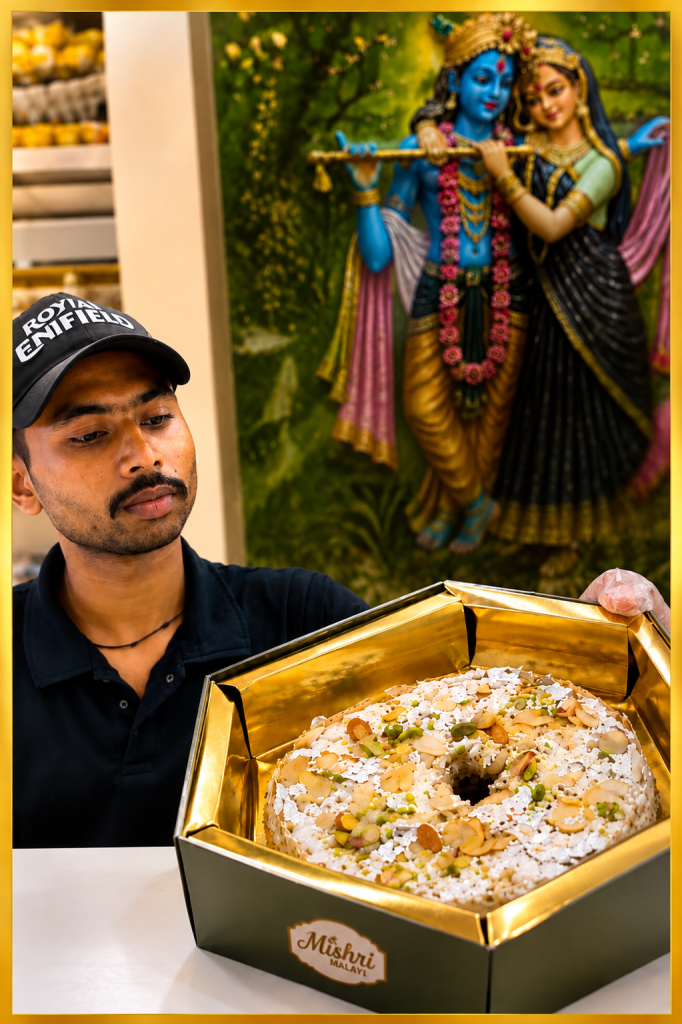
The gentle showers of rain, the earthy fragrance of wet soil, and the greenery of Sawan bring back countless memories. For me, one such beautiful memory of the monsoon has always been connected with Ghevar.
Ghevar has always been one of my favourite Indian sweets. Especially during Sawan and around Raksha Bandhan, it becomes difficult for me to resist its unique taste. The moment I see those beautifully arranged, honeycomb-like Ghevars at sweet shops, I know that the rains have also brought the festive season along with them.
But Ghevar is special not just because of its taste. It also carries a fascinating story of tradition, family bonds and emotions.
Ghevar is primarily considered a traditional sweet of Rajasthan and is particularly associated with Jaipur. There is no single, well-documented historical account establishing exactly when or how it originated, but it has long been a part of Rajasthan’s food culture and is closely associated with festivals such as Hariyali Teej, Sawan and Raksha Bandhan.
Its distinctive texture also sets it apart from most Indian sweets. A thin batter made from flour and ghee is carefully poured into hot ghee or oil to create its characteristic porous, honeycomb-like structure. It is then soaked or coated with sugar syrup. Over time, several variations have become popular, including plain Ghevar, Malai Ghevar, Mawa Ghevar and Rabri Ghevar.
For me, however, the most beautiful story of Ghevar lies not in its recipe, but in the relationships associated with it.
In many North Indian families, there has long been a tradition of sending Ghevar and gifts from a woman’s parental home to her marital home during Teej and Sawan. In Rajasthan, this is also associated with traditions such as Sinjara. When Ghevar arrives along with clothes, bangles, mehendi and other gifts, it carries something much more precious—the love and affection of the parental home.
Perhaps this is what makes Indian food culture so beautiful. A sweet is not merely something to eat; sometimes, it becomes a messenger of love between families.
Anil Tripathi, founder of Mishri Malai Sweets in Lucknow, says, “Ghevar is connected with both the season and tradition. Its demand begins to rise with the arrival of Sawan and continues through Teej and Raksha Bandhan. Even today, many families continue the tradition of sending Ghevar to their married daughters.”
Today, almost every sweet is available throughout the year. Modern markets and technology have largely erased seasonal boundaries. Yet some flavours are best enjoyed in their own season. Mangoes in summer, Gajar ka Halwa in winter, and for me, Ghevar during the monsoon—the wait itself makes them taste even more special.
Perhaps that is why Ghevar has never been just another sweet for me.
It is the taste of Sawan showers, the sweetness of Rakhi, the tradition of Teej, and the affection that travels from a daughter’s parental home to her new family.

