✍️ Mohit Dhawan
Lucknow, 23 August 2026
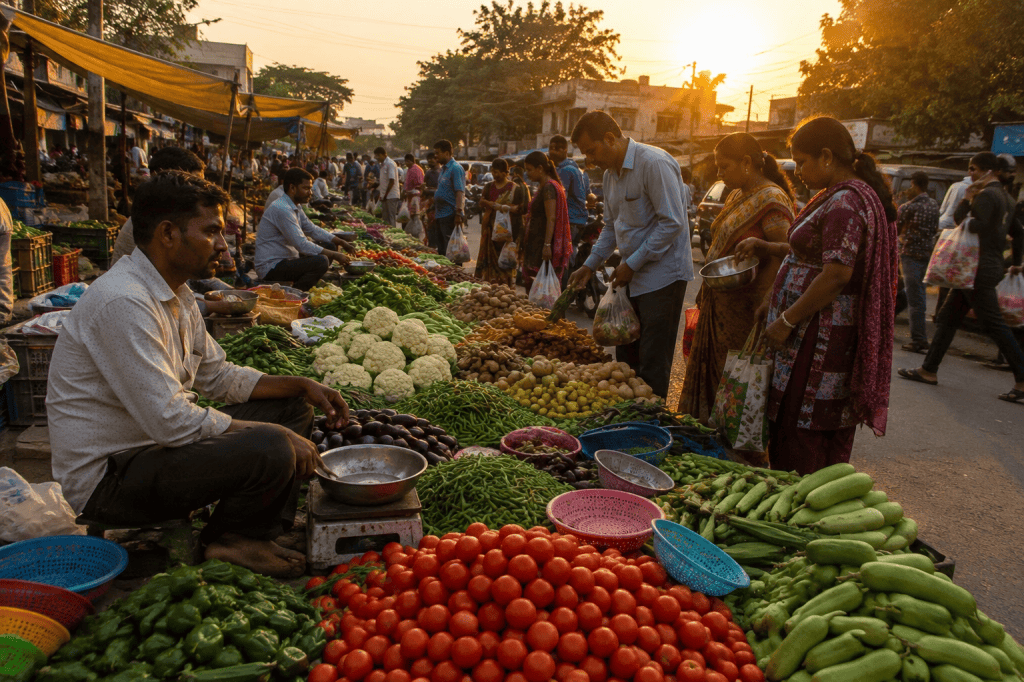
Perhaps there is a weekly market somewhere near your home too. There may be someone’s father or uncle sitting behind a small stall, earning a living and supporting his family through what he sells that day.
There was a time when such markets were a natural part of our lives. But in the age of online deliveries and large supermarkets, the way we shop is changing rapidly. A few taps on a phone, and everything from vegetables to groceries arrives at our doorstep. Convenience has increased, but somewhere along the way, perhaps we are slowly forgetting the road that once took us to our neighbourhood market.
Recently, I visited one such weekly market in Arjunganj, Lucknow. It comes alive twice a week—on Wednesdays and Saturdays. As evening approaches, stalls line the roadside, and soon the area is filled with colours, voices and the familiar bustle of a local bazaar.
It may be called a vegetable market, but there is much more to it. Fruits, spices, clothes, utensils, household goods and food stalls can all be found here. The crowd grows between 6 and 9 pm, with many people stopping on their way home from work.
Local shoppers say several items are available here at lower prices than on online platforms or in supermarkets, although vegetable prices naturally change with season and supply.
Walking through the market brought back memories of my childhood. My father would hold my hand and take me along to buy vegetables. Occasionally, when he was not around, I would get the responsibility of going to the market myself—and that came with a little extra excitement. The reason was innocent: whatever loose change remained after shopping often became my pocket money.
Despite all those visits, there are two skills I never really mastered—choosing vegetables and bargaining.
My mother used to complain about it, and after marriage, my wife took over the same responsibility: “You never learnt how to select vegetables or bargain. Whatever the shopkeeper gives you, you simply bring home!”
Perhaps it is these little moments that keep markets alive in our memories. Even today, a vegetable market reminds me not merely of shopping, but of my father’s hand, the happiness of saving a few coins and the complaints waiting for me when I returned home.
This time, however, my visit was not limited to nostalgia. I spoke to several vendors, and their conversations revealed another side of the bazaar.
Some have been coming to these markets for four or five years, while others have been doing so for nearly 42 years. They have witnessed not just changing prices, but a transformation in customers and the culture of shopping.
One thought repeatedly emerged from these conversations. They say earnings were lower in the past, yet household expenses could somehow be managed. Today, earnings may have increased, but expenses have risen much faster. Education, rent, electricity, healthcare and everyday necessities have made running a household far more difficult.
Changing shopping habits are another concern. Several vendors see online shopping and large supermarkets as part of this shift. Buying through a phone is convenient, products are delivered home, and discounts often attract customers.
But it would be unfair to turn this into a battle between online shopping and traditional markets. Customers will naturally choose convenience and value. The real question is: how do we ensure that small vendors continue to have a place in this changing marketplace?
Parking and traffic are other challenges. When the Arjunganj market is busy, the number of vehicles increases and inadequate parking can lead to congestion. This is not unique to Lucknow. Across Indian cities and towns, weekly markets are trying to find their place within rapidly changing urban landscapes.
Perhaps your city or town also has a market that appears on a particular day—Wednesday Market, Saturday Market, or simply a bazaar known by a local name. For a few hours, a small economy comes alive. Behind every vegetable, fruit, clothes or utensil stall is a family and its everyday needs.
The answer, perhaps, is not to remove these markets but to organise them better. Proper parking, cleanliness, lighting, waste management and traffic arrangements could make them more convenient for shoppers as well as vendors.
Today, vegetables can reach our doorstep with a few taps on a screen. That convenience is part of modern life. But a screen does not carry the voice of a familiar vendor, the little exchange over prices, or the warmth of recognising a face week after week.
So, the next time you pass a weekly market in your city, stop for a while. Carry a bag, choose your vegetables, exchange a few words with the vendor—and perhaps bargain a little too, something I still haven’t managed to learn!
Who knows, your purchase may bring a smile to a small vendor’s face…
and as you return with a bag full of vegetables, an old childhood memory may quietly return home with you too.

